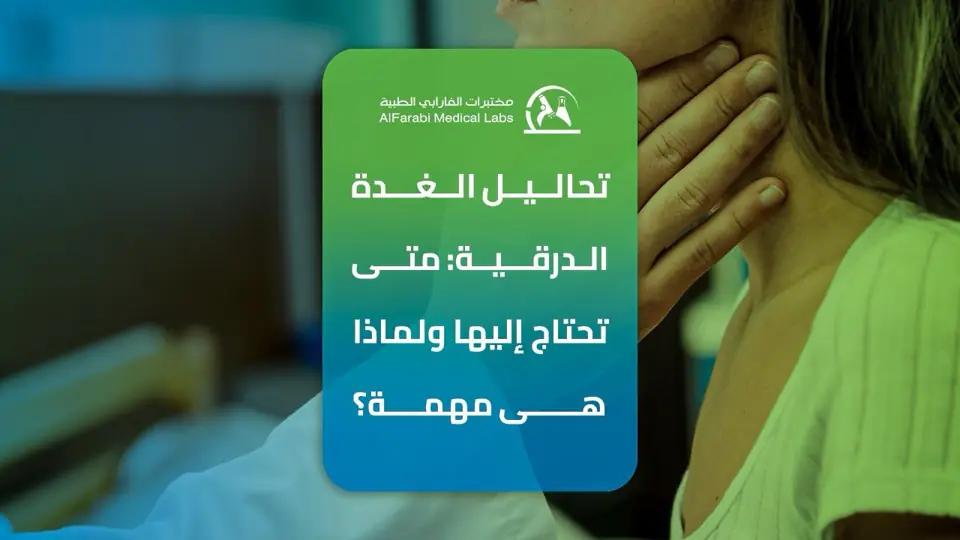
Thyroid Tests: When Do You Need Them and Why Are They Important?
Article outline
Introduction
What is the thyroid gland and what does it do?
What are the basic thyroid tests?
When do you need thyroid tests?
The importance of early diagnosis of thyroid disorders
Why choose AlFarabi Medical Labs for thyroid testing?
Conclusion
Frequently asked questions (FAQs)
Introduction
The thyroid gland may be small, but it controls essential functions in the body, making it one of the most important glands of all. It regulates metabolism, energy production and even the health of the heart, brain and skin. Any dysfunction may cause troublesome symptoms such as weight gain, sluggishness, hair loss or even anxiety and sleep disturbances.
But how do we know whether the gland is working correctly? This is where thyroid tests come in, accurately measuring hormone levels and helping the doctor identify whether the problem is underactivity or overactivity. With thyroid disorders increasing worldwide, regular testing has become a necessity rather than a luxury.
In Saudi Arabia, many doctors and patients rely on AlFarabi Medical Labs as their first destination for these tests because of its accuracy and use of modern international technologies.
What is the thyroid gland and what does it do?
The thyroid is a small, butterfly-shaped gland at the front of the neck, immediately below the larynx. Despite its small size, it plays a major role in maintaining the body's balance.
The gland's main functions
- Producing T3 (triiodothyronine) and T4 (thyroxine) hormones.
- Controlling the metabolic rate.
- Regulating body temperature.
- Contributing to growth and development, especially in children.
- Influencing heart and circulatory health.
The gland's importance in daily life
Imagine your body as a car engine and the thyroid gland as the accelerator. When it becomes overactive, the engine runs too fast, causing anxiety, a racing heartbeat and weight loss. When it becomes underactive, the body becomes slow and exhausted, with weight gain and dry skin.
Any disturbance in thyroid function, even a slight one, therefore has a clear effect on a person's physical and psychological health.
What are the basic thyroid tests?
Thyroid testing is not just one test, but a group of tests requested by the doctor according to symptoms. Each has a specific function that helps diagnose the condition accurately.
TSH test (thyroid-stimulating hormone)
- The first and main test requested by the doctor.
- Measures the amount of hormone released by the brain to stimulate the gland.
- High TSH means the gland is working slowly (underactivity).
- Low TSH indicates an overactive gland.
Free T3 and Free T4 tests
- Measure the hormones produced by the gland itself.
- Help determine the severity of underactivity or overactivity.
- Sometimes TSH is abnormal while these hormones are normal, or vice versa, so measuring them completes the picture.
Antibody tests (Anti-TPO, Anti-TG)
- Used to detect immune diseases that attack the gland, such as:
- Hashimoto's disease (causes underactivity).
- Graves' disease (causes overactivity).
- The presence of these antibodies establishes that the problem is related to autoimmunity rather than being temporary.
Additional tests
- Calcitonin test: detects certain thyroid tumors.
- Ultrasound: examines shape and size.
Together, these tests provide a comprehensive picture of the gland's condition and enable the doctor to develop a precise treatment plan.
When do you need thyroid tests?
Symptoms indicating an underactive thyroid
- Persistent fatigue and sluggishness.
- Weight gain despite eating little.
- Hair loss and dry skin.
- Marked sensitivity to cold.
- Slow thinking or poor concentration.
Symptoms indicating an overactive thyroid
- Unexplained weight loss.
- Rapid heartbeat.
- Excessive nervousness and anxiety.
- Excessive sweating.
- Sleep disturbances.
When should testing be done even without symptoms?
- A family history of thyroid problems.
- During pregnancy or immediately after childbirth.
- In people over forty.
- In people with diabetes and other immune diseases.
Some cases may occur without clear symptoms, so doctors recommend regular testing, especially for higher-risk groups.
The importance of early diagnosis of thyroid disorders
Thyroid dysfunction may begin gradually without strong symptoms at first. Over time, however, the problem worsens and affects different organs.
Main benefits of early diagnosis
- Preventing serious complications:
- Underactivity may lead to depression, obesity and heart problems.
- Overactivity may cause osteoporosis and serious heart rhythm disturbances.
- Improving quality of life:
- Early treatment restores balance quickly, improving energy, mood and even concentration.
- Easier treatment:
- The earlier the diagnosis, the simpler and more effective the treatment plan.
- Monitoring chronic conditions:
- Some people need regular tests to monitor treatment effects and adjust doses.
Why choose AlFarabi Medical Labs for thyroid testing?
With growing demand for thyroid testing, choosing a laboratory is crucial. AlFarabi Medical Labs is a trusted destination in Saudi Arabia for several reasons:
1. Accurate results using the latest equipment
- Advanced technologies ensure accurate results even with small samples.
2. Fast report delivery
- Most test results are delivered within just 48 hours, with clear, easy-to-understand reports.
3. Comprehensive, integrated packages
- Integrated packages include TSH, T3, T4 and antibody tests at competitive prices.
4. Customer comfort
- Easy online booking or direct visits to a branch.
- Home testing for sample collection without travel.
5. Doctors' and customers' trust
- Thousands of doctors rely on AlFarabi Medical Labs results daily to make precise treatment decisions.
Conclusion
Thyroid tests are more than a routine examination. They are an essential step toward understanding your health better. Thyroid disorders may explain many symptoms we consider temporary, such as exhaustion or weight gain.
With AlFarabi Medical Labs, you can be confident that your results will be accurate, fast and reliable, giving your doctor the full picture needed to make the right decision.
If you experience any symptoms or belong to an at-risk group, do not wait too long. Begin your journey with early diagnosis, because your health deserves the best.
Frequently asked questions (FAQs)
- How often should thyroid testing be done? Once a year is usually recommended for healthy people, and sometimes every 3 - 6 months for thyroid patients or at-risk groups.
- Are thyroid tests painful? They involve a simple blood draw from a vein and take only minutes.
- Can they be done at home through AlFarabi Medical Labs? Yes, AlFarabi Medical Labs provides home sample collection with the same accuracy and quality.
- What is the difference between underactivity and overactivity?
- Underactivity: reduced hormone production → causes sluggishness and weight gain.
- Overactivity: increased hormone production → causes weight loss and anxiety.
- Are thyroid results affected by fasting or food? Most thyroid tests are not affected by food, but it is best to ask the laboratory or doctor before testing.
A test result is not a diagnosis. Show it to your doctor.